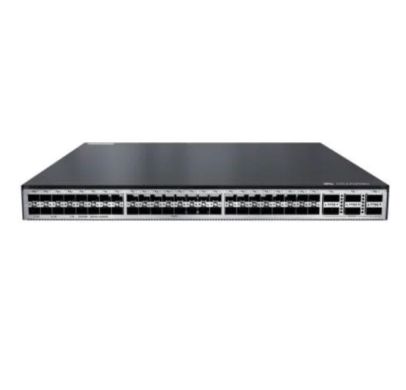
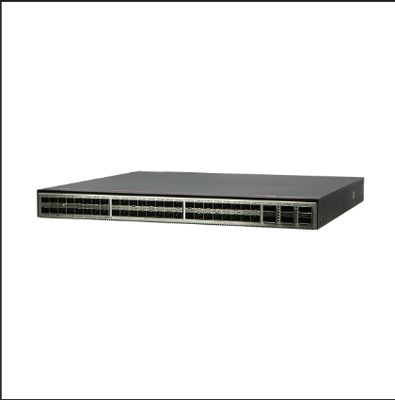
| Fixed ports |
48 x 10 Gig SFP+, 6 x 40/100 Gig QSFP28 |
| Dimensions (W x D x H) |
442 mm x 420 mm x 43.6 mm |
| Chassis height(U) |
1U |
| Input voltage |
- AC Power
- Rated AC voltage: 100V to 240V AC; 50/60 Hz
- Max. AC voltage: 90V to 290V AC; 45–65 Hz
- DC Power
- Rated DC voltage: –48V~–60V
- Max. DC voltage:-38.4V DC~-72V DC
|
| Input current |
- AC 600W:Max 8A
- DC 1000W:Max 30A
|
| Maximum power consumption |
274W |
| Minimum power consumption |
97W |
| Operating temperature |
- 0–1800 m altitude: -5°C to 45°C
- 1800–5000 m altitude: The operating temperature reduces by 1°C every time the altitude increases by 220 m.
|
| Storage temperature |
-40-70℃ |
| Operating altitude |
5000 m |
| Noise (sound pressure at normal temperature) |
65dB(A) |
| Surge protection specification |
- AC power interface: differential mode: ±6kV: common mode: ±6kV
- DC power interface: differential mode: ±2kV: common mode: ±4kV
|
| Power supply type |
- 600W AC Power
- 1000W DC Power
|
| Relative humidity |
5% to 95% (non-condensing) |
| Fans |
4, Fan modules are pluggable |
| Heat dissipation |
Heat dissipation with fan, intelligent fan speed adjustment |
| MAC |
- Up to 384K MAC address entries
- IEEE 802.1d standards compliance
- MAC address learning and aging
- Static, dynamic, and blackhole MAC address entries
- Packet filtering based on source MAC addresses
|
| VLAN |
- 4K VLANs
- Guest VLANs and voice VLANs
- GVRP
- MUX VLAN
- VLAN assignment based on MAC addresses, protocols, IP subnets, policies, and ports
- VLAN mapping
|
| ARP |
|
| IP routing |
- Static routes, RIP v1/2, RIPng, OSPF, OSPFv3, IS-IS, IS-ISv6, BGP, BGP4+, ECMP, routing policy
- Up to 256K FIBv4 entries
- Up to 80K FIBv6 entries
|
| Interoperability |
- VLAN-Based Spanning Tree (VBST), working with PVST, PVST+, and RPVST
- Link-type Negotiation Protocol (LNP), similar to DTP
- VLAN Central Management Protocol (VCMP), similar to VTP
|
| Wireless service |
- AP access control, AP domain management, and AP configuration template management
- Radio management, unified static configuration, and dynamic centralized management
- WLAN basic services, QoS, security, and user management
- CAPWAP, tag/terminal location, and spectrum analysis
|
| Ethernet loop protection |
- RRPP ring topology and RRPP multi-instance
- Smart Link tree topology and Smart Link multi-instance, providing millisecond-level protection
- switchover
- SEP
- ERPS (G.8032)
- BFD for OSPF, BFD for IS-IS, BFD for VRRP, and BFD for PIM
- STP (IEEE 802.1d), RSTP (IEEE 802.1w), and MSTP (IEEE 802.1s)
- BPDU protection, root protection, and loop protection
|
| MPLS |
- MPLS L3VPN
- MPLS L2VPN (VPWS/VPLS)
- MPLS-TE
- MPLS QoS
|
| IPv6 features |
- Neighbor Discover (ND)
- PMTU
- IPv6 Ping, IPv6 Tracert, IPv6 Telnet
- ACLs based on source IPv6 addresses, destination IPv6 addresses, Layer 4 ports, or protocol types
- Multicast Listener Discovery snooping (MLDv1/v2)
- IPv6 addresses configured for sub-interfaces, VRRP6, DHCPv6, and L3VPN
|
| Multicast |
- IGMP v1/v2/v3 snooping and IGMP fast leave
- Multicast forwarding in a VLAN and multicast replication between VLANs
- Multicast load balancing among member ports of a trunk
- Controllable multicast
- Port-based multicast traffic statistics
- IGMP v1/v2/v3, PIM-SM, PIM-DM, and PIM-SSM
- MSDP
- Multicast VPN
|
| QoS/ACL |
- Rate limiting in the inbound and outbound directions of a port
- Packet redirection
- Port-based traffic policing and two-rate three-color CAR
- Eight queues on each port
- DRR, SP, and DRR+SP queue scheduling algorithms
- WRED
- Re-marking of the 802.1p and DSCP fields of packets
- Packet filtering at Layer 2 to Layer 4, filtering out invalid frames based on the source MAC address, destination MAC address, source IP address, destination IP address, TCP/UDP source/destination port number, protocol type, and VLAN ID
- Queue-based rate limiting and shaping on ports
|
| Security |
- Hierarchical user management and password protection
- DoS attack defense, ARP attack defense, and ICMP attack defense
- Binding of the IP address, MAC address, port number, and VLAN ID
- Port isolation, port security, and sticky MAC
- MAC Forced Forwarding (MFF)
- Blackhole MAC address entries
- Limit on the number of learned MAC addresses
- IEEE 802.1X authentication and limit on the number of users on a port
- AAA authentication, RADIUS authentication, and HWTACACS authentication
- NAC
- SSH V2.0
- HTTPS
- CPU protection
- Blacklist and whitelist
- Attack source tracing and punishment for IPv6 packets such as ND, DHCPv6, and MLD packets
- IPSec for management packet encryption
- ECA
- Deception
|
| Reliability |
- LACP
- E-Trunk
- Ethernet OAM (IEEE 802.3ah and IEEE 802.1ag)
- ITU-Y.1731
- DLDP
- LLDP
- BFD for BGP, BFD for IS-IS, BFD for OSPF, BFD for static routes
|
| VXLAN |
- VXLAN functions, VXLAN L2 and L3 gateways, BGP EVPN
- VXLAN configuration using NETCONF/YANG
|
| SVF |
- Acting as the parent node to vertically virtualize downlink switches and APs as one device for
- management
- Two-layer client architecture
- ASs can be independently configured. Services not supported by templates can be configured on
- the parent node.
- Third-party devices allowed between SVF parent and clients
|
| iPCA |
- Marking service packets to obtain the packet loss ratio and number of lost packets in real time
- Measurement of the number of lost packets and packet loss ratio on networks and devices
|
| Management and maintenance |
- Cloud-based management
- Virtual cable test
- SNMP v1/v2c/v3
- RMON
- Web-based NMS
- System logs and alarms of different severities
- GVRP
- MUX VLAN
- NetStream
- Telemetry
|


 Your message must be between 20-3,000 characters!
 English